
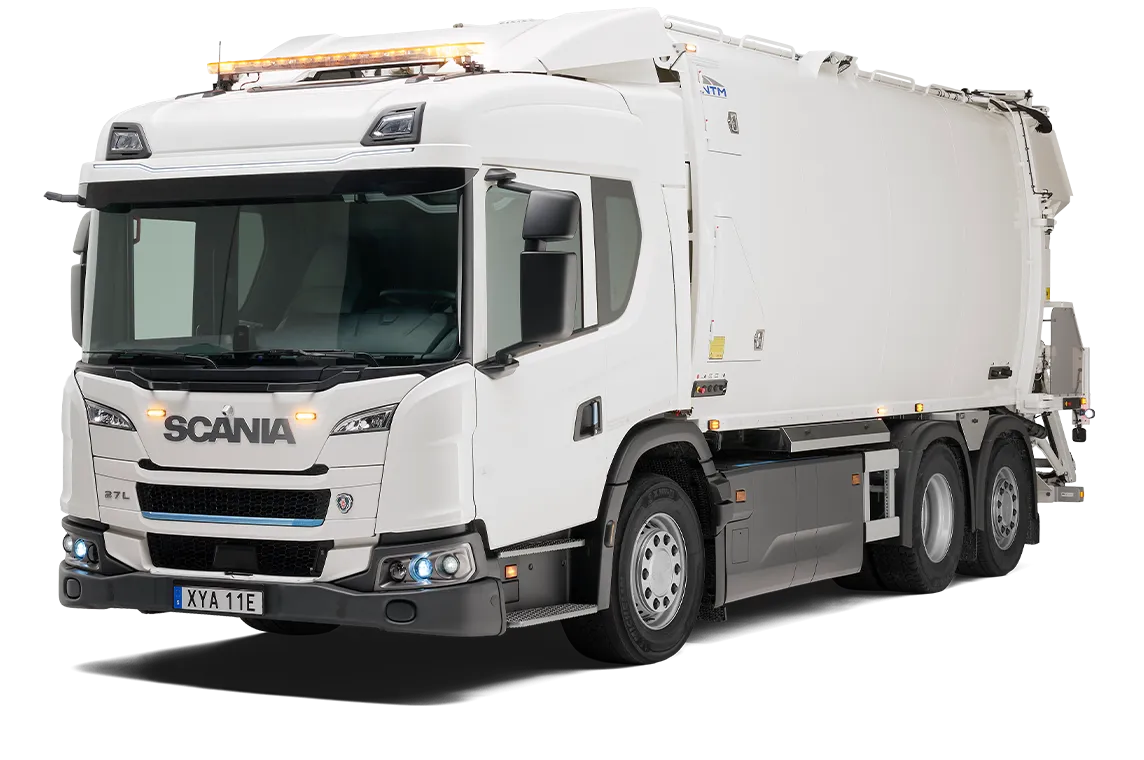

The Scania L-series can be a very safe choice for utility operations when specified with the correct optional equipment. In this case it was tested as a refuse collection vehicle. The L-series achieved a very good performance in both Safe Driving and Collision Avoidance, earning our CitySafe award alongside its 5 stars. It is available with all of the driver assistance systems Euro NCAP assess and they perform well to support from urban stop/start operations to highway driving. The low entry cab provides excellent direct vision. Whilst the conventional rear view mirrors can create localised blind areas, the camera monitor systems provide continuous views around the front nearside corner specifically and all around the vehicle generally. The Scania L-series is available with a top-performing AEB system for nearside turn collisions with cyclists which is especially important reflecting the likely use of this vehicle. The AEB system also performs well in frontal vehicle, pedestrian and cyclist scenarios. The vehicle tested was a battery electric variant, which complies with Euro NCAP’s post crash safety requirements. Overall, the L-series can be a very safe vehicle for utility operations provided that the appropriate options are selected at purchase.
L-Series features a low entry cab and optional bus style door which aids crew access and maximises direct vision, achieving full points in the Euro NCAP assessment. It retains conventional mirrors for the class II/IV views which can be useful for two-way driver/operative vision and communication, although they do block sideways vision creating localised blind areas. The standard fit class V/VI camera monitor system replaces conventional kerb and pedestrian mirrors, providing a continuous view around front nearside corner of the vehicle. An optional fit surround area view camera monitor system also provides an overhead view all around the vehicle. A seat belt reminder is fitted on all seats, encouraging belt use. The attention assist system exceeds minimum legal requirements without excessive false alerts. Use of the ACC addresses the risk of front to rear collisions in stop/start traffic and when travelling to refuse sites on faster roads. A close following distance warning is not available.
The Scania L-series can be a very safe choice for utility operations when specified with the correct optional equipment. In this case it was tested as a refuse collection vehicle. The L-series achieved a very good performance in both Safe Driving and Collision Avoidance, earning our CitySafe award alongside its 5 stars. It is available with all of the driver assistance systems Euro NCAP assess and they perform well to support from urban stop/start operations to highway driving. The low entry cab provides excellent direct vision. Whilst the conventional rear view mirrors can create localised blind areas, the camera monitor systems provide continuous views around the front nearside corner specifically and all around the vehicle generally. The Scania L-series is available with a top-performing AEB system for nearside turn collisions with cyclists which is especially important reflecting the likely use of this vehicle. The AEB system also performs well in frontal vehicle, pedestrian and cyclist scenarios. The vehicle tested was a battery electric variant, which complies with Euro NCAP’s post crash safety requirements. Overall, the L-series can be a very safe vehicle for utility operations provided that the appropriate options are selected at purchase.
L-Series features a low entry cab and optional bus style door which aids crew access and maximises direct vision, achieving full points in the Euro NCAP assessment. It retains conventional mirrors for the class II/IV views which can be useful for two-way driver/operative vision and communication, although they do block sideways vision creating localised blind areas. The standard fit class V/VI camera monitor system replaces conventional kerb and pedestrian mirrors, providing a continuous view around front nearside corner of the vehicle. An optional fit surround area view camera monitor system also provides an overhead view all around the vehicle. A seat belt reminder is fitted on all seats, encouraging belt use. The attention assist system exceeds minimum legal requirements without excessive false alerts. Use of the ACC addresses the risk of front to rear collisions in stop/start traffic and when travelling to refuse sites on faster roads. A close following distance warning is not available.
The Scania L-series can be a very safe choice for utility operations when specified with the correct optional equipment. In this case it was tested as a refuse collection vehicle. The L-series achieved a very good performance in both Safe Driving and Collision Avoidance, earning our CitySafe award alongside its 5 stars. It is available with all of the driver assistance systems Euro NCAP assess and they perform well to support from urban stop/start operations to highway driving. The low entry cab provides excellent direct vision. Whilst the conventional rear view mirrors can create localised blind areas, the camera monitor systems provide continuous views around the front nearside corner specifically and all around the vehicle generally. The Scania L-series is available with a top-performing AEB system for nearside turn collisions with cyclists which is especially important reflecting the likely use of this vehicle. The AEB system also performs well in frontal vehicle, pedestrian and cyclist scenarios. The vehicle tested was a battery electric variant, which complies with Euro NCAP’s post crash safety requirements. Overall, the L-series can be a very safe vehicle for utility operations provided that the appropriate options are selected at purchase.
L-Series features a low entry cab and optional bus style door which aids crew access and maximises direct vision, achieving full points in the Euro NCAP assessment. It retains conventional mirrors for the class II/IV views which can be useful for two-way driver/operative vision and communication, although they do block sideways vision creating localised blind areas. The standard fit class V/VI camera monitor system replaces conventional kerb and pedestrian mirrors, providing a continuous view around front nearside corner of the vehicle. An optional fit surround area view camera monitor system also provides an overhead view all around the vehicle. A seat belt reminder is fitted on all seats, encouraging belt use. The attention assist system exceeds minimum legal requirements without excessive false alerts. Use of the ACC addresses the risk of front to rear collisions in stop/start traffic and when travelling to refuse sites on faster roads. A close following distance warning is not available.


Seat Belt Usage | |
Driver Monitoring | |
Direct Vision | Volume:20.4m³ | |
Indirect Vision | |
Speed Assistance | |
Adaptive Cruise Control | |
Car | |
Pedestrian & Cyclist | |
Lane Departure | |
Car | |
Turn Across the Path of a Cyclist | |
Rescue Sheet & Guide | |
External Labelling | |
Advanced e-Call | |
Occupant Extrication | |
Seat Belt Reminder Driver |  |
Seat Belt Reminder Passenger | |
Seat Belt Reminder Centre Passenger |  |
Attention Assist Direct Monitoring |  |
Attention Assist Indirect Monitoring | |
e-Mirrors Class II | |
e-Mirrors Class IV | |
e-Mirrors Class V | |
e-Mirrors Class VI | |
e-Mirrors Class II & Class IV | |
Speed Assistance | |
Adaptive Cruise Control |  |
Lower Door Window | |
Seat Belt Reminder Driver | |
Seat Belt Reminder Passenger | |
Seat Belt Reminder Centre Passenger | |
Attention Assist Direct Monitoring | |
Attention Assist Indirect Monitoring | |
e-Mirrors Class II | |
e-Mirrors Class IV | |
e-Mirrors Class V | |
e-Mirrors Class VI | |
e-Mirrors Class II & Class IV | |
Speed Assistance | |
Adaptive Cruise Control | |
Lower Door Window | |
AEB | |
AEB Pedestrian & Cyclist | |
Lane Keep Assist | |
Cyclist Nearside Turn | |
Emergency Lane Keeping | |
Rescue Sheet & Guide | |
External Labelling | |
Advanced e-Call | |
Occupant Extrication | |
Note: Other equipment may be available on the vehicle but was not considered in the test year.