Euro NCAP tests all major truck brands on the market. Trucks are generally made specifically for a particular task such as distribution, construction or delivery. This type of customisation makes truck testing more complicated than passenger car testing. There may be different vehicle lengths, axle and drive combinations as well as different cab sizes in the case that the truck is being used for local distribution work or long-distance haulage. Euro NCAP conducts a range of tests and assessments to assess the safety performance of four truck categories.

Euro NCAP classifies trucks into four main sectors
that cover the European N2 and N3 classification.
Long haul covering international
Fleet Distribution covering regional and city
Construction covering on and off-road vehicles
Utility covering refuse, fire and specialist vehicles
Long Haul covering international
Fleet Distribution covering regional and city
Construction covering on and off-road vehicles
Utility covering refuse, fire and specialist vehicles
The selected vehicle will be common to that sector which will cover axles and length and will be equipped with an appropriate body for that application. Whilst operators may have specific requirements, the ratings and safety performance of the vehicles would be the same even where lengths or axles differ. However, cab and chassis height can vary significantly and that can have a negative impact on Direct Vision scores.
Euro NCAP’s member organisations sponsor at least one truck test per year, often picking a model that’s important in their country. Truck manufacturers can also request their own models to be assessed but the testing process is identical for all. Trucks are provided by the manufacturers and are built to order with a specification typical for the application. A rigorous process is employed to ensure that the vehicle is to production specification and is representative of a vehicle ordered by an operator across Europe. It is important that fleets and operators using Euro NCAP's information to select a safe vehicle understand that a vehicle must be ordered with the same optional equipment as that fitted to the test vehicle to achieve the safety performance suggested.
To encourage greater safety of trucks, Euro NCAP conducts a range of tests and assessments, which include: approaching a slower moving & stationary car – turn across the path of a cyclist – pedestrian crossing the road – lane keep assist – emergency lane keeping in overtaking traffic.
Vision is a key part of the assessment of a truck’s safety. The eyepoint of the driver is generally higher than that of other road users due to the height of the cab, and the driver’s view can be restricted. Vision is calculated by volume in cubic metres and is carried out either virtually or a specialist optical device mounted at the drivers eyepoint. A higher volumetric measurement gives a greater score. Better indirect vision is encouraged by replacing regulated Class 2 and 4 (rear vision) and Class 5 and 6 (near field vision) with cameras. These give an improved and dynamic view for the driver. Manufacturers that replace all mirrors with a Camera Monitoring System (CMS) are awarded the highest score.
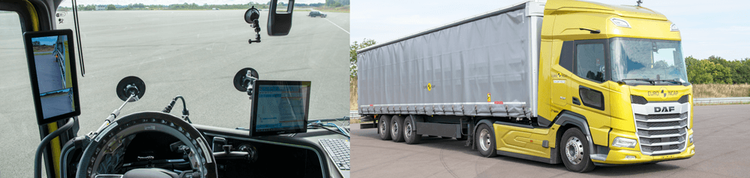
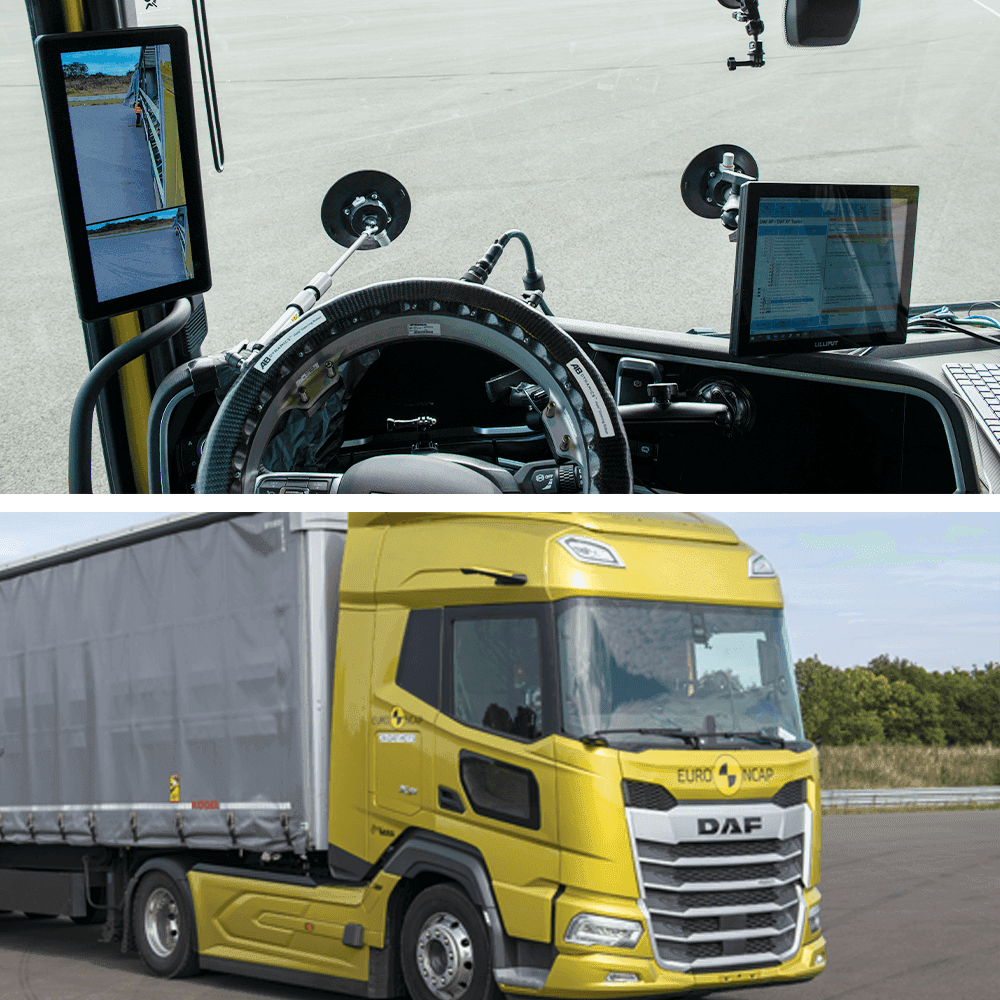
Vision is a key part of the assessment of a truck’s safety. The eyepoint of the driver is generally higher than that of other road users due to the height of the cab, and the driver’s view can be restricted. Vision is calculated by volume in cubic metres and is carried out either virtually or a specialist optical device mounted at the drivers eyepoint. A higher volumetric measurement gives a greater score. Better indirect vision is encouraged by replacing regulated Class 2 and 4 (rear vision) and Class 5 and 6 (near field vision) with cameras. These give an improved and dynamic view for the driver. Manufacturers that replace all mirrors with a Camera Monitoring System (CMS) are awarded the highest score.
With long travel distances, Long Haul trucks can especially benefit from Adaptive Cruise Control (ACC). Speed Assistance systems help control the speed of the vehicle to keep within safe and legal limits and can be used to prevent over-speeding on long downhill highway sections. Testing through on-road driving allow the reliability and consistency of the system to be evaluated, and this includes variable speed limits and sections of road that require differing limits for heavy commercial vehicles.
Active safety tests assess how well a vehicle's driver-assist and crash-avoidance technologies work. These tests evaluate both the effectiveness of these systems in preventing or mitigating crashes, and the technology's robustness across various real-world scenarios. The technologies assessed today include car-to-car, car-to-pedestrian and car-to-cyclist Autonomous Emergency Braking (AEB) systems, Lane Support Systems (LSS). Unique to trucks are specialist near side turn AEB systems that can prevent collisions with cyclists as the vehicle turns – a growing issue in cities. In all Crash Avoidance evaluations, impactable soft dummy targets are used and the tests undertaken under scientific conditions at specialist test track facilities. The targets represent full size cars, motorcycles, walking adult and child pedestrians as well as cyclists. Vehicles are controlled via robots to ensure closely controlled and repeatable test conditions.
At present Euro NCAP does not evaluate the passive safety features of trucks. However, in 2028 restraint systems such as pre-tensioners and airbags will be added to the assessment and work is being undertaken to introduce a whole vehicle crash test in 2031. This will not only protect the driver but also aims to encourage the truck manufacturers to offer protection for an opposing vehicle of lower weight such as a car – a concept known as compatibility.
Emergency services personnel who are first on the scene of a crash can be at risk if they are unaware of the location of high voltage batteries, fuel tanks, airbag inflators and seatbelt pre-tensioners. Their work can be hampered by locked vehicle doors and windows, and high-strength body structures. To assist with the safe rescue and extrication of occupants, vehicle manufacturers are encouraged to provide standardised vehicle information highlighting the location of potential rescue hazards in the form of a Rescue Guide. All available information is displayed in Euro NCAP’s Euro Rescue app for use by first responders. Future evaluations will consider eCall systems which recognise when a truck is involved in a crash and notify first responders. Consideration will also be given to systems that offer post-crash braking – to stop the vehicle when it's involved in an initial crash where a driver may be incapacitated.
Euro NCAP evaluates driver monitoring technologies that maintain attention and engagement behind the wheel. From 2028, consideration will be given to focus on improved system reliability and user acceptance. Points will be awarded for advanced systems that monitor driver behaviour in real time. To achieve the highest ratings, vehicles must not only employ continuous eye- and head-tracking but also link driver state information to the sensitivity of driver assistance systems. Additional credit may be given to technologies that can identify signs of drug or alcohol impairment and those capable of safely bringing the vehicle to a halt if the driver becomes unresponsive. New assessments of the human–machine interface (HMI) evaluate the placement, clarity and ease of use of essential controls — including the availability of physical buttons for commonly used functions, which consumer feedback suggests can reduce distraction. Vehicles able to detect whether seatbelts are being worn correctly – and optimise restraint and airbag systems for different driver and passenger physiques – will earn higher scores. Verification of speed-limit information accuracy will be conducted during on-road driving tests.