Whether you are a driver delivering flowers or parcels, servicing heating systems, or heading to a building site, knowing you are fully prepared for any potential danger or changes to driving conditions, is reassuring. Accidents can have a big impact on your business, with downtime and loss of the use of your vehicle. Euro NCAP’s five-star rating can show businesses and tradespeople which models feature the most effective safety systems. Euro NCAP carries out a range of assessments, including crash testing from 2026.

There is overwhelming evidence that ADAS technologies reduce crashes, deaths, and injuries, protecting drivers and other road users. Readily available on passenger cars, we believe businesses should prioritise the fitment of these vital safety solutions on their fleet vehicles
Euro NCAP’s star rating system makes it easy to select the safest vehicle for your operation by summarising the results of a comprehensive range of safety tests. For each pillar of safety, vehicles undergo detailed assessments and must meet minimum score thresholds, with individual technologies and functions weighted according to their real-world effectiveness. Systems that can prevent more crashes or reduce the severity of injuries are therefore given a higher relative value. These weighted scores are combined to produce an overall rating for each safety pillar, which is then translated into a clear and simple star rating from zero to five stars.

Five stars: A vehicle that offers superior safety across a wide range of functionalities and offers the best protection for both occupants and those around the vehicle equipped with high performing collision avoidance systems.

Four stars: A vehicle that offers significant safety benefits across a range of functions and offers a good balance protecting driver, passenger and other road users alike.

Three stars: A vehicle that offers some significant safety functionality beyond legal requirements but only in certain areas.

Two stars: A vehicle that just passes current regulations and offers some safety systems or functions beyond legal requirements. Other vehicles offer more safety.

One star: A vehicle that just passes current regulations and offers some minor additional safety functionality.

Zero stars: A vehicle that just passes current regulations and offers no safety systems or functions beyond legal requirements.
Euro NCAP carries out numerous tests and evaluations of all relevant safety technology. The functionality evaluated often goes beyond that required by law and aims to identify those systems that offer significantly better performance to protect your driver and brand. The tests are designed to reflect real-life accidents, helping fleets and businesses choose the safest option for their operation. Van safety is evaluated in 4 key areas or pillars representing the stages of a crash.
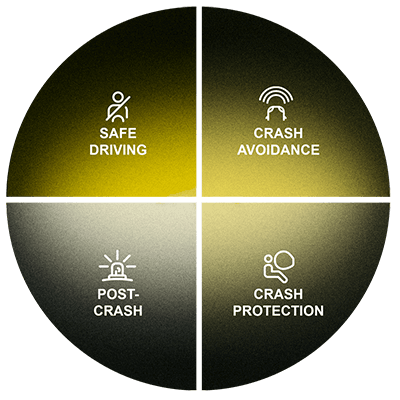
Safe Driving represents the hours and minutes before a crash where drivers may need support. Euro NCAP evaluates driver monitoring systems to ensure a drowsy driver is alerted and that safety belts are worn. Speed assistance systems help to control the vehicle and keep it within safe limits. Systems can assist the driver even where variable speed limits are in place and limits for vans can be different to passenger cars.
Crash Avoidance represents the seconds prior to a collision where Advanced Driver Assistance Systems (ADAS) can help mitigate or avoid a collision. Systems such as Autonomous Emergency Braking (AEB) can identify a vehicle in front or a crossing pedestrian and automatically brake. Lane Keep Assist (LKA) can prevent a distracted driver from crossing a lane into the path of an oncoming car.
Crash Protection, introduced in 2026, encourages manufacturers to protect their drivers during an actual crash with improved restraints – airbags and pretensioners.
Post-Crash Safety focuses on the so-called golden hour; the vital 60 mins that the emergency services require to get access to occupants involved in vehicle crashes. eCall technologies can help notify where a collision has occurred.
Making a van safer involves a combination of structural integrity for crash protection, and Advanced Driver Assistance Systems (ADAS) such as Autonomous Emergency Braking (AEB) and Lane Support Systems (LSS). A good ADAS system, fitted to a van, can greatly assist drivers in avoiding an accident or mitigating the severity of a crash. Euro NCAP’s testing of vans’ ADAS technologies began in 2021 and today, Euro NCAP’s five-star rating is increasingly used as a benchmark for the safety strategies for many businesses.
Advanced Driver Assistance Systems (ADAS) combine sensors to help foresee a potential collision and warn or intervene to help prevent casualties and damage. Cameras and radars can identify other vehicles, pedestrians and cyclists, and can also warn the driver or ideally intervene to help mitigate or prevent a collision. Autonomous Emergency Braking (AEB) systems are encouraged by Euro NCAP to address crashes by automatically braking the vehicle. Cameras are also used to monitor road markings and help make sure the vehicle does not inadvertently steer out of lane. Where possible, Euro NCAP ensures that these systems do not annoy the driver when a warning is unnecessary.