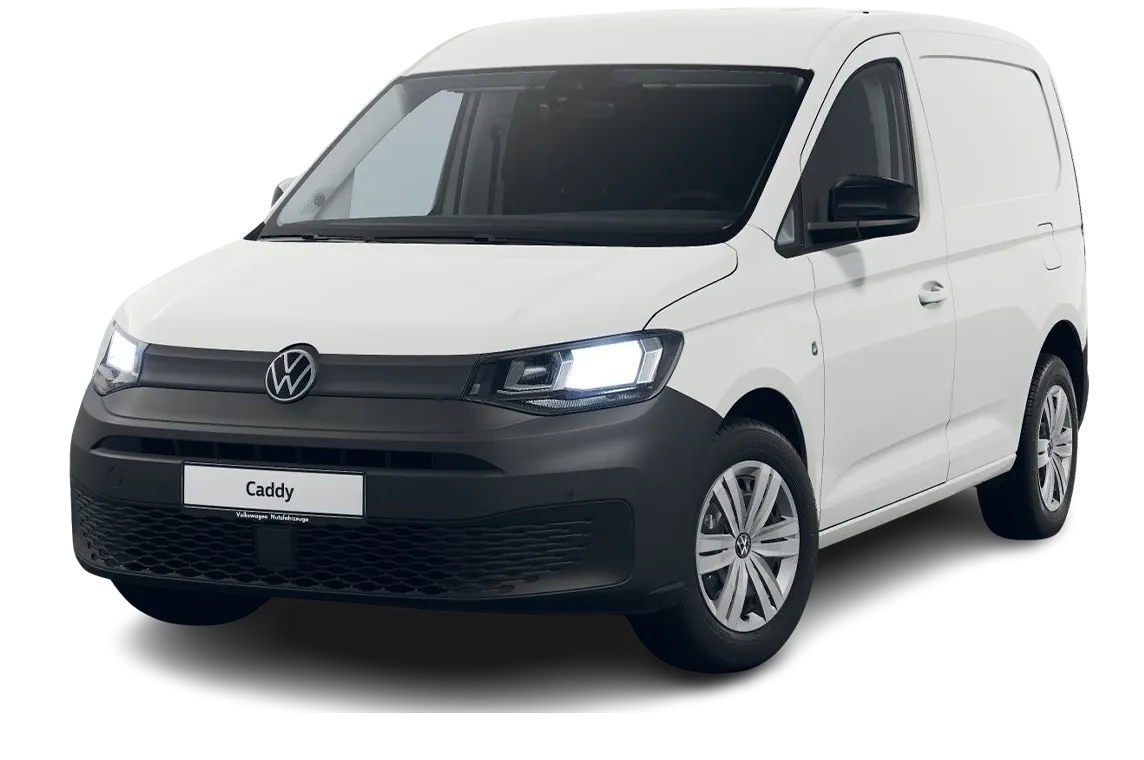
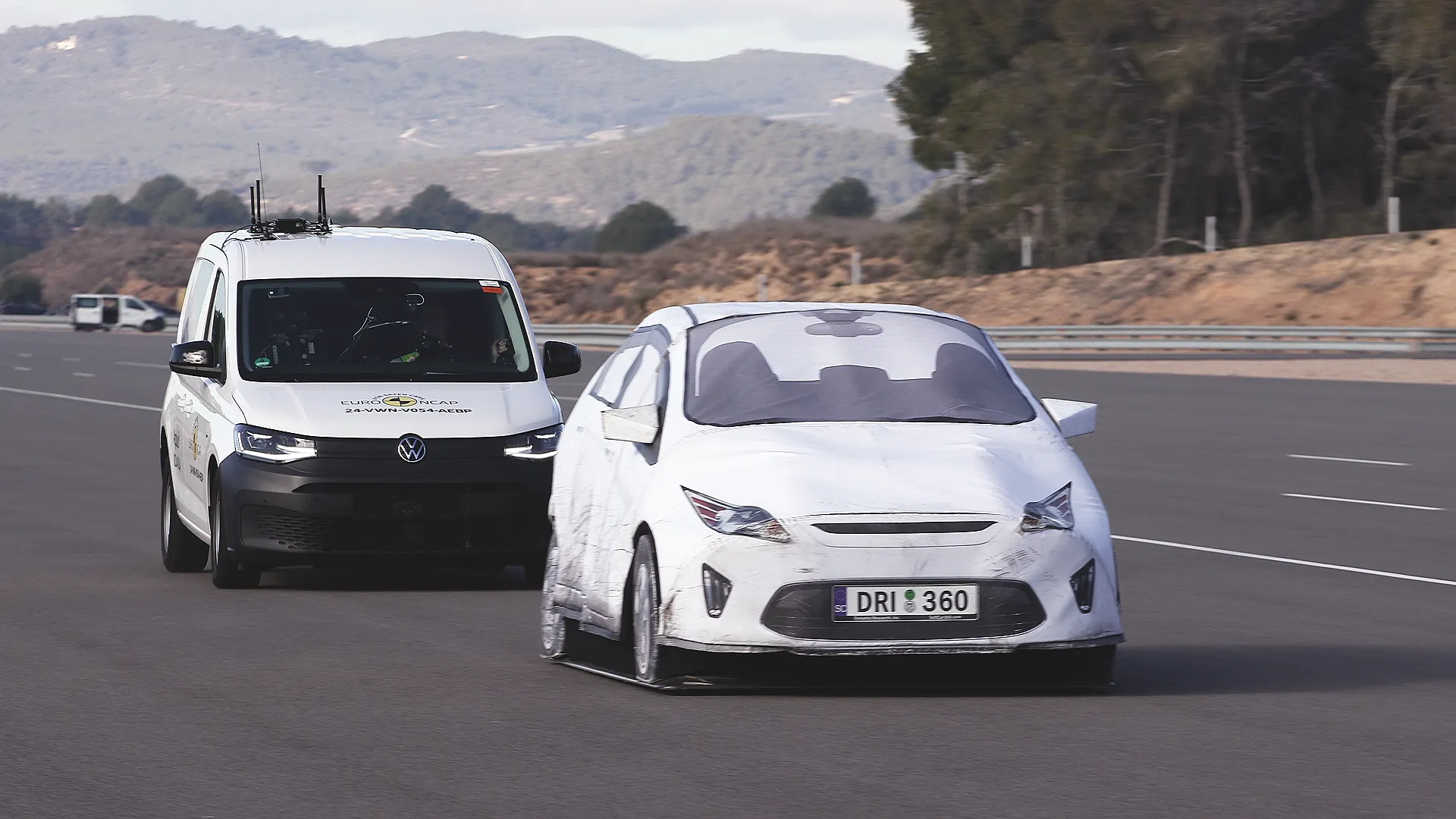
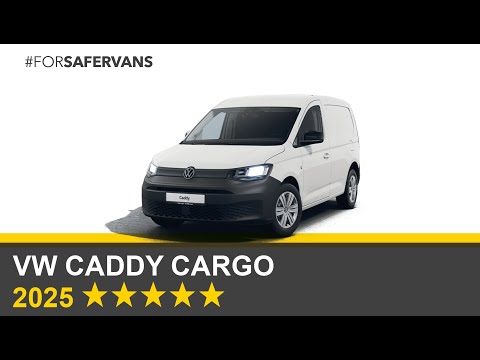

The Caddy name has been around for decades, referring to several generations of VW commercial vehicles. The vehicle tested here is the fifth generation, in diesel form. A new version is coming soon which promises better performance than this one but even as it is the Caddy offers a lot of safety equipment, some of it as standard, and performs well. A Gold medal is well-deserved and reflects VW's policy of keeping their models up-to-date when it comes to safety.The autonomous emergency braking (AEB) system uses camera and radar fusion technology to detect other vehicles and vulnerable road users such as pedestrians and cyclists. Performance is generally when approaching a stationary, but tails off for the forward-collision warning at higher test speeds. Performance is better against a slower-moving vehicle. The system performs equally well whether the target vehicle is straight in front of it or offset to one side or the other, but the system does not react in scenarios where a vehicle turns across the path of the approaching van. With a pedestrian target, the system performs well in all scenarios, including those done in night-time conditions, but does not detect people behind the van when it is reversing. The Caddy Cargo also performs well in most of the test scenarios involving a cyclist, including those where the van is approaching a person cycling along the roadside.
The lane support system includes lane departure warning, which signals to the driver when the van is drifting out of lane, and emergency lane keeping, which intervenes more aggressively in certain critical situations to prevent the van from leaving the road. The system performed well but did not react either to the Euro NCAP target or to a real car in some of the overtaking scenarios. It includes blind spot monitoring to help the driver not to pull out in front of an overtaking vehicle.
The Caddy Cargo has a driver set speed limiter, accurate to within 5 km/h, as standard. However, unlike some modern vehicles, the Caddy does not provide information to the driver about the local speed limit.
A seatbelt reminder is standard for the driver and front passenger seat, and the Caddy Cargo recognises steering behaviour which is characteristic of fatigued driving, alerting the driver to the need for a break.
The Caddy name has been around for decades, referring to several generations of VW commercial vehicles. The vehicle tested here is the fifth generation, in diesel form. A new version is coming soon which promises better performance than this one but even as it is the Caddy offers a lot of safety equipment, some of it as standard, and performs well. A Gold medal is well-deserved and reflects VW's policy of keeping their models up-to-date when it comes to safety.The autonomous emergency braking (AEB) system uses camera and radar fusion technology to detect other vehicles and vulnerable road users such as pedestrians and cyclists. Performance is generally when approaching a stationary, but tails off for the forward-collision warning at higher test speeds. Performance is better against a slower-moving vehicle. The system performs equally well whether the target vehicle is straight in front of it or offset to one side or the other, but the system does not react in scenarios where a vehicle turns across the path of the approaching van. With a pedestrian target, the system performs well in all scenarios, including those done in night-time conditions, but does not detect people behind the van when it is reversing. The Caddy Cargo also performs well in most of the test scenarios involving a cyclist, including those where the van is approaching a person cycling along the roadside.
The lane support system includes lane departure warning, which signals to the driver when the van is drifting out of lane, and emergency lane keeping, which intervenes more aggressively in certain critical situations to prevent the van from leaving the road. The system performed well but did not react either to the Euro NCAP target or to a real car in some of the overtaking scenarios. It includes blind spot monitoring to help the driver not to pull out in front of an overtaking vehicle.
The Caddy Cargo has a driver set speed limiter, accurate to within 5 km/h, as standard. However, unlike some modern vehicles, the Caddy does not provide information to the driver about the local speed limit.
A seatbelt reminder is standard for the driver and front passenger seat, and the Caddy Cargo recognises steering behaviour which is characteristic of fatigued driving, alerting the driver to the need for a break.
The Caddy name has been around for decades, referring to several generations of VW commercial vehicles. The vehicle tested here is the fifth generation, in diesel form. A new version is coming soon which promises better performance than this one but even as it is the Caddy offers a lot of safety equipment, some of it as standard, and performs well. A Gold medal is well-deserved and reflects VW's policy of keeping their models up-to-date when it comes to safety.The autonomous emergency braking (AEB) system uses camera and radar fusion technology to detect other vehicles and vulnerable road users such as pedestrians and cyclists. Performance is generally when approaching a stationary, but tails off for the forward-collision warning at higher test speeds. Performance is better against a slower-moving vehicle. The system performs equally well whether the target vehicle is straight in front of it or offset to one side or the other, but the system does not react in scenarios where a vehicle turns across the path of the approaching van. With a pedestrian target, the system performs well in all scenarios, including those done in night-time conditions, but does not detect people behind the van when it is reversing. The Caddy Cargo also performs well in most of the test scenarios involving a cyclist, including those where the van is approaching a person cycling along the roadside.
The lane support system includes lane departure warning, which signals to the driver when the van is drifting out of lane, and emergency lane keeping, which intervenes more aggressively in certain critical situations to prevent the van from leaving the road. The system performed well but did not react either to the Euro NCAP target or to a real car in some of the overtaking scenarios. It includes blind spot monitoring to help the driver not to pull out in front of an overtaking vehicle.
The Caddy Cargo has a driver set speed limiter, accurate to within 5 km/h, as standard. However, unlike some modern vehicles, the Caddy does not provide information to the driver about the local speed limit.
A seatbelt reminder is standard for the driver and front passenger seat, and the Caddy Cargo recognises steering behaviour which is characteristic of fatigued driving, alerting the driver to the need for a break.


Seat Belt Usage | |
Driver Monitoring | |
Speed Assistance | |
Adaptive Cruise Control | |
Steering Assistance | |
Car | |
Pedestrian & Cyclist | |
Lane Departure | |
Car | |
Pedestrian | |
Rescue Sheet & Guide | |
Advanced e-Call | |
Occupant Extrication | |
AEB Car |  |
AEB Pedestrian & Cyclist | |
Lane Support Systems | |
AEB Car | |
AEB Pedestrian & Cyclist | |
Lane Support Systems | |
Seat Belt Reminder Driver | |
Seat Belt Reminder Passenger | |
Driver Monitoring |  |
Speed Assistance | |
Adaptive Cruise Control | |
Steering Assistance |  |
Note: Other equipment may be available on the vehicle but was not considered in the test year.